
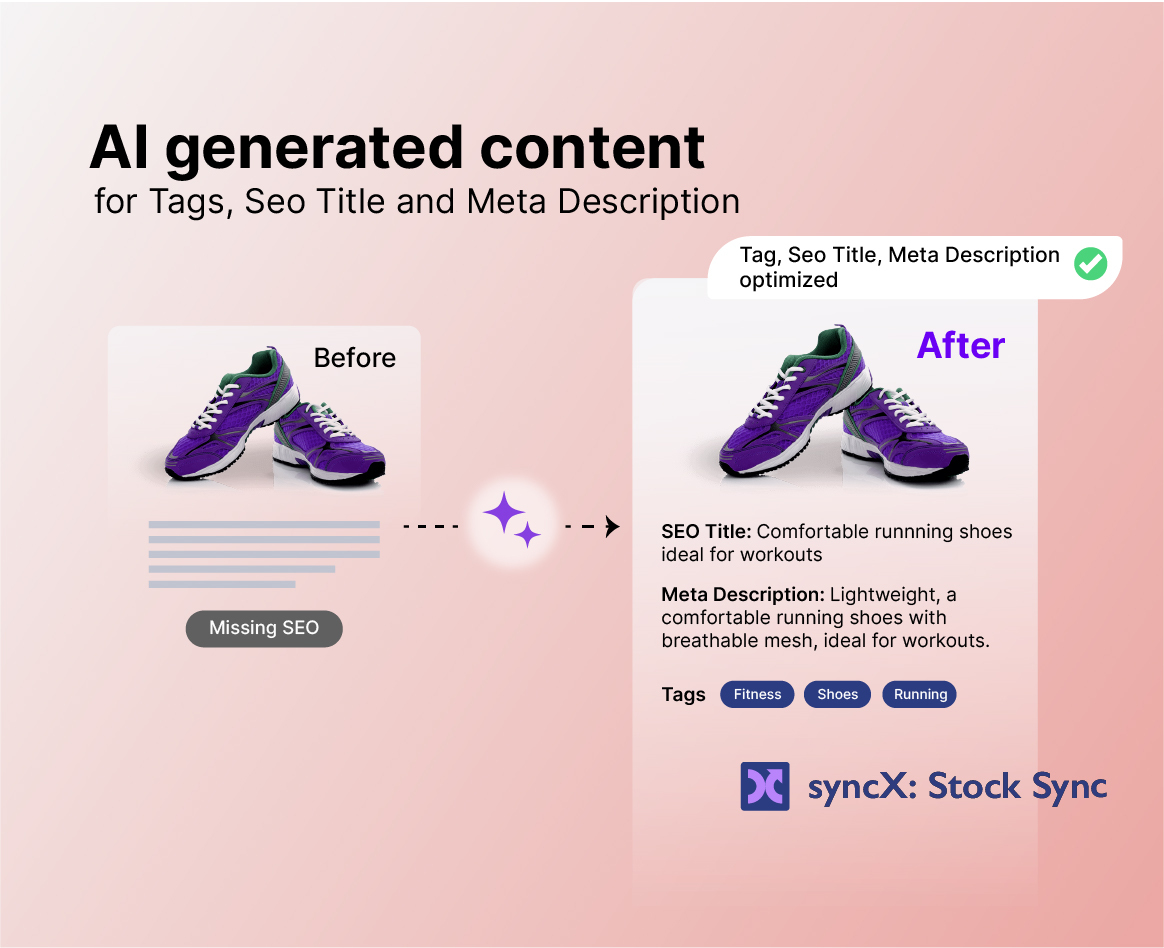
AI Inventory Sync: Automate Product SEO During Every Sync


Stop manual data entry during product syncs. Use SyncX to automatically generate Shopify tags, SEO titles, meta descriptions, and product categories directly from your inventory feed.
Key Takeaways
- AI inventory sync automatically generates missing SEO fields, such as product information, SEO titles, and meta descriptions, during product imports.
- It helps turn incomplete supplier feeds into a more SEO-ready Shopify storefront with less manual work.
- Merchants can launch products faster, improve product discoverability, and improve product ranking in search results.
- syncX: Stock Sync combines inventory automation with AI-generated content in a single product sync workflow.
Why Incomplete Supplier Feeds Slow Down Product Launches
Manual product sync is challenging enough, but it becomes even slower when your supplier feed is missing the content your Shopify store needs for search.
You may import hundreds of products with complete SKUs, prices, and inventory levels, only to find the SEO fields are empty. Without product tags, SEO titles, or meta descriptions, your products are live but not fully prepared for discovery.
Instead of manually filling every missing field, syncX: Stock Sync uses AI inventory sync to generate product tags, SEO titles, and meta descriptions during the sync process. This helps you build a more AI-optimized ecommerce store, reduce spreadsheet cleanup, and save time on repetitive data entry.
What Is AI Inventory Sync?
AI inventory sync combines automation and artificial intelligence to update product data while generating missing content fields as part of the same workflow.
A standard inventory sync updates fields such as SKUs, stock quantity, price, vendor, product type, and variant data.
AI inventory sync uses the existing product information in your feed to generate product tags, SEO titles, and meta descriptions.
AI does not generate content from scratch. It analyzes available product details, such as product names, descriptions, categories, vendors, attributes, and other mapped fields, to create relevant product content.
Instead of optimizing products after every import, AI inventory sync makes SEO preparation part of your existing sync workflow.
Why Blank SEO Fields Hurt Your Store
A product can be synced correctly and still underperform if it is not properly prepared for search and discovery.
When SEO fields are missing or weak, several issues can arise:
- Products become harder to find in search engines
- Click-through rates from search results may drop
- Product organization becomes less efficient
- Collection filtering becomes less effective
- Teams spend more time on administrative work
- Product launches take longer
This challenge is especially common because supplier feeds are often designed for inventory systems rather than ecommerce storefronts. While they usually include basic product data, they often lack the content needed to help shoppers discover and understand products.
Managing catalog maintenance may work for a small catalog, but it quickly becomes a bottleneck as your business grows.
How syncX: Stock Sync Solves the Missing Data Problem
.jpg)
syncX: Stock Sync helps automate product imports and inventory updates from supplier feeds, spreadsheets, FTP, APIs, cloud storage, ERP systems, and other data sources.
With AI-generated content, syncX: Stock Sync can also fill missing SEO and tagging fields during the sync process, so your inventory data and product content stay updated in one workflow.
When setting up Matching Columns, simply enable AI Generation for selected fields. SyncX analyzes the available product data and generates relevant content for your ecommerce store.
- Product Tags and Product Category That Improve Store Organization
Product tags help organize your catalog, support filtering, and make products easier to browse.
Instead of tagging products manually, syncX: Stock Sync generates relevant tags from your product data to improve smart collections, catalog organization, and shopper navigation.
This is especially useful for merchants managing large or complex supplier catalogs.
- SEO Titles That Are Search-Friendly
SEO titles help search engines and shoppers understand what a product page is about.
If supplier product names are too short, inconsistent, or not optimized for search, SyncX can generate clearer SEO titles before products go live.
- Meta Descriptions That Support Better Clicks
Meta descriptions give shoppers a short preview of your product page in search results.
SyncX generates relevant meta descriptions automatically, helping your product pages become more content-ready without manual writing.
How to Turn On AI Generation in syncX: Stock Sync
Enabling AI Generation in syncX: Stock Sync is simple and requires no changes to your existing product feed. You only need to activate the feature during the matching process.
Follow these three steps:
- Go to Matching Columns
Open your feed settings and go to Step 2: Matching Columns, where you map supplier feed columns to your store's product fields. - Select AI Generation
For fields such as product tags or SEO fields, choose the AI-generated option from the dropdown.
Instead of importing values directly from your supplier feed, SyncX generates the missing content using the available product data. - Run the Sync
Run the sync. SyncX analyzes your product data and automatically populates the selected fields during each update.
Why AI Inventory Sync Matters for Growing E-commerce Stores
Growth usually creates more product data work.
As you add suppliers, expand your catalog, or prepare seasonal launches, product information can quickly become inconsistent.
One supplier may provide clean titles and categories. Another may send only basic SKUs, prices, and stock levels. Some feeds may not be built for ecommerce use at all.
That slows down product launches and creates extra cleanup before items are ready to sell.
AI inventory sync helps turn raw supplier data into cleaner, more complete product listings during the sync process. This is especially useful when you are:
- Adding a new supplier
- Expanding your product catalog
- Launching a new store
- Cleaning up existing product data
- Preparing for seasonal campaigns
- Managing large SKU volumes
Instead of letting incomplete data delay product updates, you can keep your catalog moving and reduce the manual work behind every launch.
Why Agencies (and Your Team) Will Love This
For agencies and ecommerce teams, content readiness can become a hidden launch blocker.
The store design may be approved. The product feed may be connected. The inventory data may be ready. But if product tags, SEO titles, and meta descriptions are missing, the catalog still needs cleanup before launch.
syncX: Stock Sync helps bridge that gap by turning raw supplier data into a more SEO-ready storefront during the sync process.
This helps agencies and teams:
- Launch product catalogs faster
- Reduce spreadsheet cleanup
- Manage large catalogs more efficiently
- Improve product organization
- Spend more time on strategy instead of repetitive tasks
For teams managing multiple stores or client catalogs, this makes product setup easier to repeat and scale.
AI Inventory Sync vs Manual Product Cleanup
Post product import cleanup may work for small catalogs, but it becomes inefficient as your product range grows.
Here is the difference:
The goal is simple: less manual entry, cleaner product data, and a storefront that is easier.
When Should You Use AI-Generated Product Content?
AI-generated product content is most useful when your existing feed has enough product information for AI to work from, but not enough complete SEO data for your storefront.
It is a good fit when you are:
- Importing products from a new supplier
- Managing a large Shopify catalog
- Cleaning up old product data
- Preparing products for launch
- Handling frequent product updates
- Building a more AI-optimized ecommerce store
- Trying to save time on repeated SEO field creation
For best results, review your generated content and make sure it matches your brand, product details, and customer expectations. AI can speed up the workflow, but your store still benefits from human judgment.
AI-generated content provides a strong starting point, but you can review and edit any generated fields to better match your brand voice or product positioning.
Use SyncX’s AI Inventory Sync to Build an SEO-Ready Store
If your supplier feed is missing SEO titles, product tags, or meta descriptions, you do not need to fix every field manually.
With syncX: Stock Sync, you can automate inventory updates and generate AI-powered product content during every sync, so products are cleaner, more complete, and easier to publish.
AI inventory sync is one part of your ecommerce automation workflow. Once products are synced with Stock Sync, you can use Order Export to automatically route new orders to suppliers, warehouses, or ERP systems, and Fulfill Tracking to sync tracking updates from suppliers or 3PLs. Together, they help automate your product, order, and fulfillment workflows.
Log in to your syncX: Stock Sync dashboard and try AI generation on your next feed update.
FAQs:
Can AI-generated content help products rank better?
Yes. AI-generated content can support SEO ranking by making product pages clearer, more complete, and easier to understand. It gives you a stronger starting point, but rankings still depend on product quality, site structure, internal links, page experience, and overall SEO strategy.
Does AI inventory sync replace SEO work?
No. AI inventory sync automates the creation of product tags, SEO titles, and meta descriptions, but it should complement—not replace—your broader SEO efforts.
Can SyncX generate SEO titles and meta descriptions automatically?
Yes. When AI Generation is enabled in Matching Columns, syncX: Stock Sync can automatically generate SEO titles and meta descriptions during product sync.
Is AI inventory sync useful for large product catalogs?
Yes. AI inventory sync helps merchants manage large product catalogs by reducing the manual effort required to prepare imported products for publication.
Will AI-generated product tags help with store organization?
Yes. AI-generated product tags help organize products, improve collection management, and make catalogs easier for customers to browse and filter.
Who should use AI inventory sync?
AI inventory sync is ideal for ecommerce merchants, dropshippers, agencies, and growing brands that regularly import products from supplier feeds and want to reduce manual product data management.
.jpg)


Start Automating Your Inventory Today


Company Reg: 1047341V
5-13-05, Block 5, VSQ @ PJ City Centre, Jln Utara, 46200 Petaling Jaya, Selangor.


.svg)